
Checking for a Warrant in Iron County
Start your Iron County warrant search with the free Utah Statewide Warrants tool from the Bureau of Criminal Identification. The Iron County Sheriff homepage carries a Check Warrants link that leads straight to that BCI service, because the sheriff posts no county-only roster of active warrants. A match there is only a lead. Take it to the court named in the result, since the issuing court controls the next step and any bond amount. Before you run the warrant lookup, gather your full legal name, your date of birth if the live portal asks for it, and any citation or case number you have. You can check your own record or help a relative with their permission. Whatever the search returns, route the answer to the office actually holding the case, whether that is the Justice Court or the district court clerk.
- Open the Utah BCI warrant page and follow its link to the statewide file.
- Use only the fields the public screen shows. The live form was not verified during research, so do not assume it asks for every field in the law-enforcement guide.
- Write down the court, case or warrant number, charge, and visible status. A same-name result needs court confirmation.
- Call Iron County Justice Court about local traffic, ordinance, or FTA matters, or Fifth District Court about a district case.
- Use the Sheriff for agency records or service questions and the Jail for custody or bond instructions. Keep the receipt or court order after action.
A warrant search can point you toward a case, but only the issuing court can recall or quash a warrant in Iron County. Confirm any status with the court or the sheriff before you act on it.
Why Iron County Sends Readers to BCI
Why point Iron County readers to the state? Because Iron County itself publishes no searchable active-warrant table online. The Sheriff's homepage routes its Check Warrants link to Utah BCI, which offers a free search of the statewide warrant file. That file covers outstanding felony, misdemeanor, and infraction warrants entered by courts across Utah, so an Iron County bench warrant or arrest warrant should appear there once the court enters it. The live portal can throw technical blocks at times. The BCI landing page still names the public service and explains its purpose, so use the live screen as presented and then call the court named in any result to confirm. The link goes to the official BCI instructions, which lay out the state handoff and how the public warrant check works.
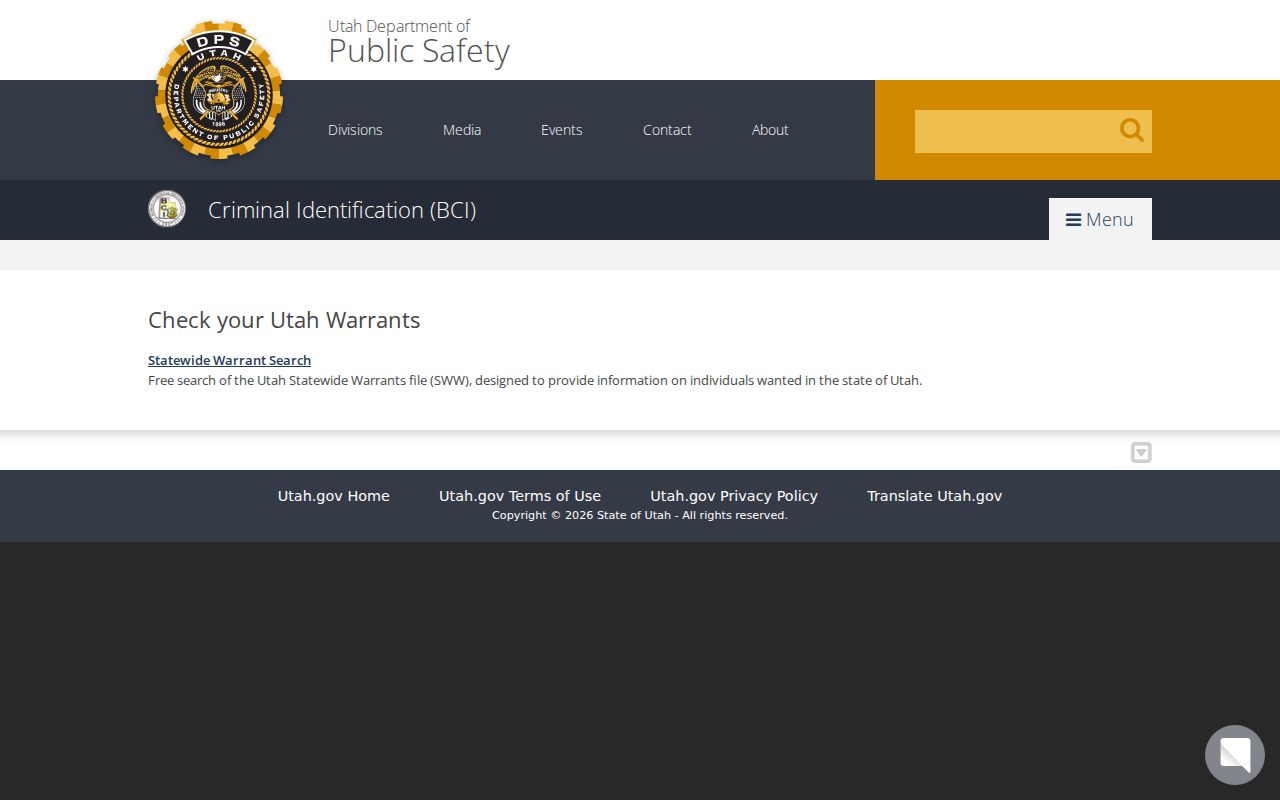
BCI is a statewide channel, not an Iron County warrant roster. It does not replace the local court clerk, who holds the actual case file.
Iron County Warrant Types
Warrant types land in different places depending on venue. Justice Court matters in Iron County often start with a ticket or a missed setting, while serious criminal cases move through Fifth District Court. Search warrants, civil body attachments, juvenile matters, and federal warrants each carry their own purpose or access rules. Knowing which court holds the case tells you where to ask.
| Type | How It Arises | Local Route |
|---|---|---|
| Arrest warrant | A judge or magistrate finds probable cause in a criminal matter. | Issuing court and named serving agency |
| Bench or FTA warrant | A required appearance or permitted payment is missed. | Iron County Justice Court for its cases |
| Search warrant | A court authorizes a search for specified evidence. | Access depends on execution, filing, and court limits |
| Civil or juvenile process | A distinct civil proceeding or youth-court matter. | Relevant court; not an ordinary adult search |
Utah materials label these bench warrants and failure-to-appear warrants. Iron County does not use capias pro fine as its local term.
Two Iron County Court Destinations
Iron County's county seat is Parowan, but the public Justice Court counter now sits in Cedar City, and Fifth District Court holds sessions in Cedar City at a separate location. The elected Iron County Clerk runs county administration, elections, licenses, and commission records, and that office is not the Clerk of the Courts. The split matters when a notice names a court. A traffic citation or city-ordinance case generally starts with Justice Court, while a felony or district-court case belongs to Fifth District Court. The Sheriff's records desk cannot recall a warrant held by either bench. The official Parowan transfer notice documents the July 1, 2025 closure of the Parowan court and the transfer of its cases. Some older Parowan cases may still point to a separate payment link, so call the current court before you pay anything.
Inside an Iron County Warrant Record
The clearest picture of a warrant record comes from BCI's technical guide and the local court interfaces. A public warrant lookup often shows less than the full underlying file. Iron County has no published warrant-number pattern or standard result layout. Treat the field table as a map of possible record parts, not a promise that every field appears online.
| Court and case | The court or source and its case number identify where to ask next. |
|---|---|
| Warrant number | A separate identifier may be listed; the local format was not verified. |
| Charge | The offense or court matter tied to the order. |
| Service status | Attempted, served, or transporting are operational labels, not case outcomes. |
| Bond or release | Ask the issuing court for the current amount and conditions. |
| Recall | The court controls recall; the public state file may update later. |
One Iron County warrant record can bundle warrants from several courts when the identity details line up. Treat a matching name as a lead, not proof.
When an Iron County Result May Lag
Warrant activity in Iron County moves through court systems into the state file at UCJIS. BCI requires courts to keep entries current and to validate them. Serving agencies send in their updates too. A recall clears from UCJIS within about an hour, but a served warrant can linger for roughly fifteen days unless someone recalls it. Those are system timings. They do not promise that every public screen refreshes at the same instant. So a blank result on a warrant lookup is not proof that no warrant exists. The gap might come from a case just filed, a lower-court file that needs a clerk's check, a sealed or juvenile matter, or a federal or out-of-state process.
- Recalled
- The issuing court withdrew the warrant.
- Served
- An agency executed it; the case may continue.
- Active
- The source still reports it unresolved. Confirm with that source.
Issuing and Serving Warrants in Iron County
In Iron County, judges and magistrates issue the warrants, and the assigned agency serves them. That could be the Sheriff, Cedar City Police, Enoch Police, Parowan Police, Utah Highway Patrol, or another authorized officer. Serving a warrant does not give that agency control over its recall. The Iron County Sheriff's official homepage points readers to BCI. For court status, ask the Justice Court or Fifth District clerk; for custody or bond questions, call the Jail.
Iron County Sheriff’s Office
2132 N Main Street, Cedar City, UT 84721
435-867-7500
The Sheriff homepage backs this office summary. The Iron County Sheriff's office sits on North Main, while the Jail and its bond desk is a separate address at 2136 N Main.
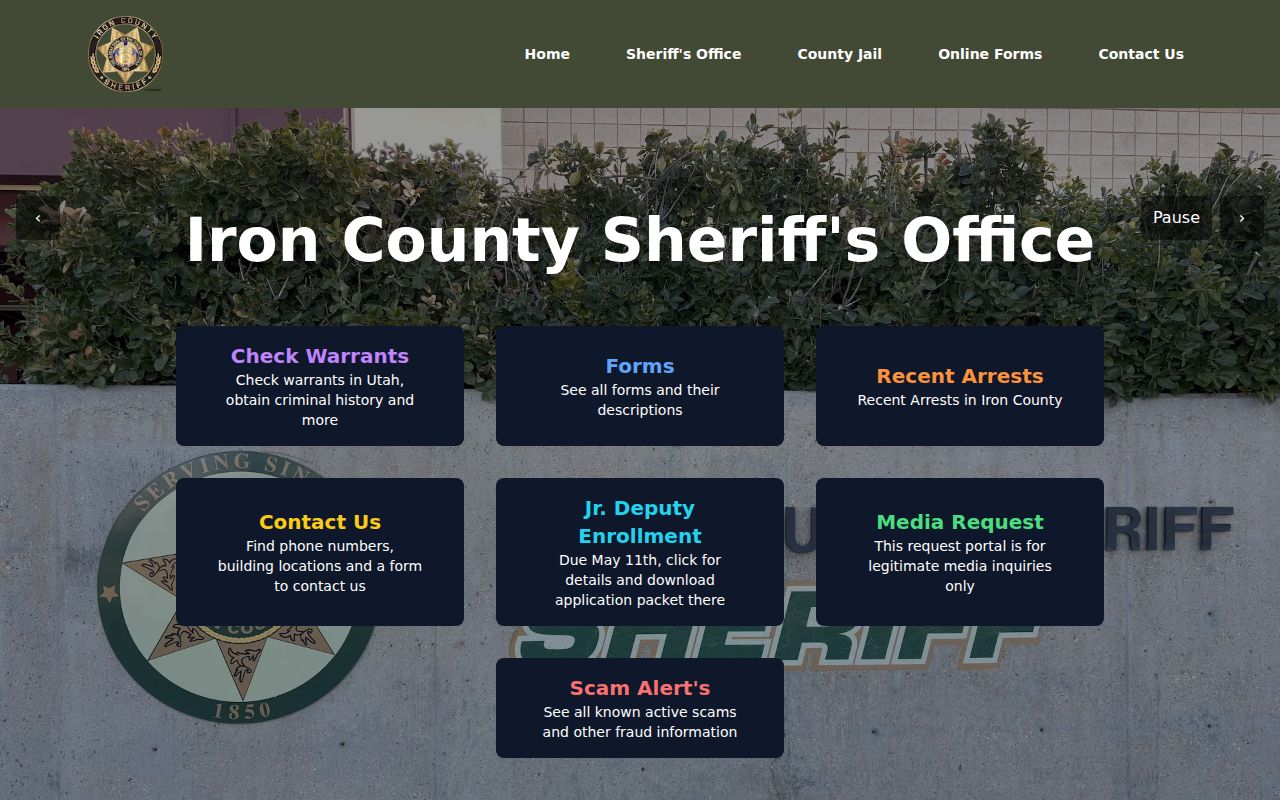
The homepage image reflects a state-system handoff. It does not show a local roster.
No Iron County Most-Wanted Roster
Iron County posts no public active-warrant roster and no curated most-wanted list. No reward program or roundup operates here either. The Sheriff's website offers a "Check Warrants" button, but it leads to the state BCI system rather than a local list. The jail booking page shows custody and bond fields, though it is not a full warrant list. Names and photos get copied nowhere. The Most Wanted List page covers the county's no-roster situation and the separate federal program that does exist.
If You Have an Iron County Warrant
Start by naming the issuing court, because that single office controls what happens next. For an Iron County Justice Court matter, call the clerk and ask what the warrant requires: payment, bail, or an appearance before the judge. One local rule matters here. Asking for a later court date does not recall the warrant on its own; the bail must be paid or the judge must see the person. A Fifth District Court arrest warrant works differently, so contact that court or an attorney about the right appearance or surrender route for the case. The Sheriff publishes no walk-in surrender hours. The Jail accepts cash or surety bonds as its official page describes, while the court sets the amount and the legal condition attached.
Important: Confirm the issuing court’s instructions before traveling, paying, or arranging a surrender; keep every receipt and court order.
Iron County Payment and Recall Steps
Traffic and failure-to-appear cases in Iron County Justice Court can be paid online or by phone, with a 2.5% processing fee added. In person, the counter handles payments during business hours, and a secure drop box opens after 4 p.m. under exact-change rules. Mail works too, using a cashier's check or money order. Personal checks are not accepted on criminal cases. Ask the clerk first whether paying affects a plea, traffic school, or a deferred option. Cash bonds go through the Jail, and surety bonds run through approved companies. Neither payment nor a bond closes the underlying case, so keep the receipt and ask the issuing court when its recall reaches the statewide system. The official Sheriff contact page lists the separate North Main locations: use the Sheriff office for agency records and the Jail for custody or bond questions.
2132 N Main is the Sheriff office; 2136 N Main is the Jail.
Iron County Warrant Records and Public Access
Utah's Government Records Access and Management Act sets the rules for government records, while court records follow Utah court-access rules. An issued arrest warrant can be public, and some executed search warrants can be too. Courts may still restrict materials. Juvenile files, sealed items, and protected agency records never show up as ordinary public results. Send any request to the office that keeps the record. A Sheriff GRAMA request cannot make a court recall an order, and no court can hand over another court's record. Iron County agencies follow these same limits.
Key access rules:
Utah Code § 63G-2-301 identifies public record classes, including certain warrant records, subject to limits.
Utah Code § 63G-2-204 sets request and response rules for records held by a government entity.
Juvenile Rule 7 governs youth-court warrant and custody processes separately.
Separate Sheriff and Court Record Requests
The Iron County Sheriff's GRAMA form reaches only records that office holds. Its records page warns a response may take up to 10 business days, and it posts no fee schedule. A Sheriff request cannot supply a court's case file or decide whether a warrant stays active. For a court document, contact the clerk for Iron County Justice Court or Fifth District Court, depending on the case. The Sheriff's records request page and the Fifth District Court directory lead to different custodians with different procedures.
Iron County Warrants by City
Iron County's five largest incorporated places each run their own police and court routes. Population figures come from the 2020 Census. A city officer may issue or serve a citation, but the named court decides payment, plea, and recall. Cedar City has a city police records route. Enoch runs its own police department page. Paragonah documents its contracted police service through Parowan, while Kanarraville offers no separate public warrant portal.
Cedar City Warrant Search
35,235 residents; city police route citations to Iron County Justice Court.
Enoch Warrant Search
7,374 residents; Enoch Police keeps agency records, while court questions go to Justice Court.
Parowan Warrant Search
2,996 residents; cases transferred from the former city court in 2025.
Paragonah Warrant Search
536 residents; police services are contracted through Parowan.
Kanarraville Warrant Search
442 residents; no separate warrant portal was located.
Iron County Search Limits to Keep in Mind
The BCI system covers Utah only, not the whole country. A clean result does not rule out a federal, out-of-state, sealed, or juvenile matter. Xchange serves as a public case-information tool, and MyCase covers a party's own case history; neither works as a real-time warrant roster. The BCI guide also warns that court entry and removal timing can affect the state file. The official statewide search page links to the live portal, so use its actual fields and confirm any result with the named court rather than assuming. Open Utah Statewide Warrants for the public search itself. For local channels, the Iron County warrant lookup process is the place to begin.
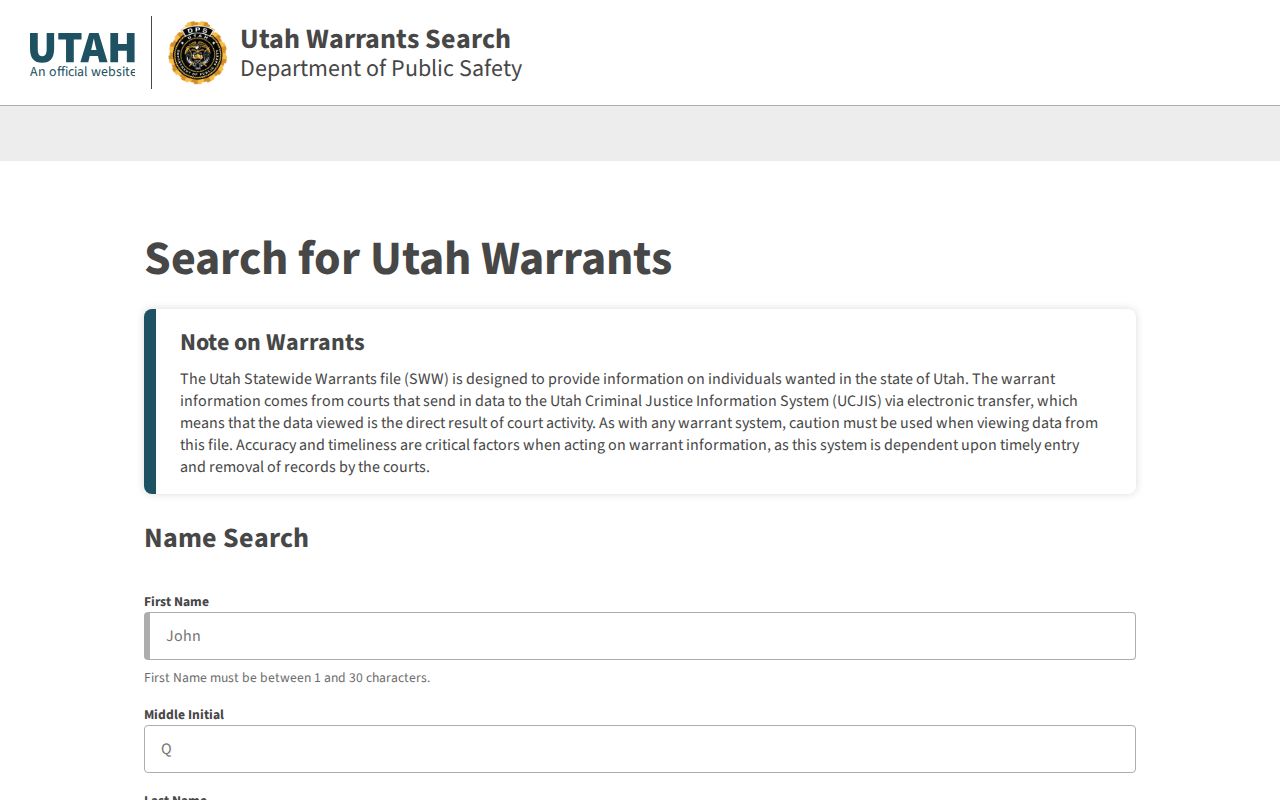
Note: The BCI guide warns that court entry and removal timing can affect the state file, so Iron County results may lag.