
Iron County Bench Warrants Explained
A bench warrant in Iron County starts as a court order, usually after a missed hearing, an unpaid amount that was due in place of an appearance, or a skipped court-directed step. Traffic and ordinance cases point to Iron County Justice Court. Felonies and district proceedings belong to Fifth District Court. The issuing court controls what happens next: payment, a judge appearance, and any recall. Deputies can serve the paper. But service and recall are separate jobs handled by separate offices. Utah forms say “bench warrant” and “failure-to-appear warrant.” Capias pro fine is not the local term here.
Iron County’s Justice Court Check
Call the clerk first. The Iron County Justice Court answers warrant questions by phone during posted weekday hours. Have your citation or case number, your full name, and any other identifying details the clerk requests. A search of BCI's statewide file can help you find the right court. Direct court confirmation still controls what happens next. The court's warrant and contact page sets out that local route, hours included.
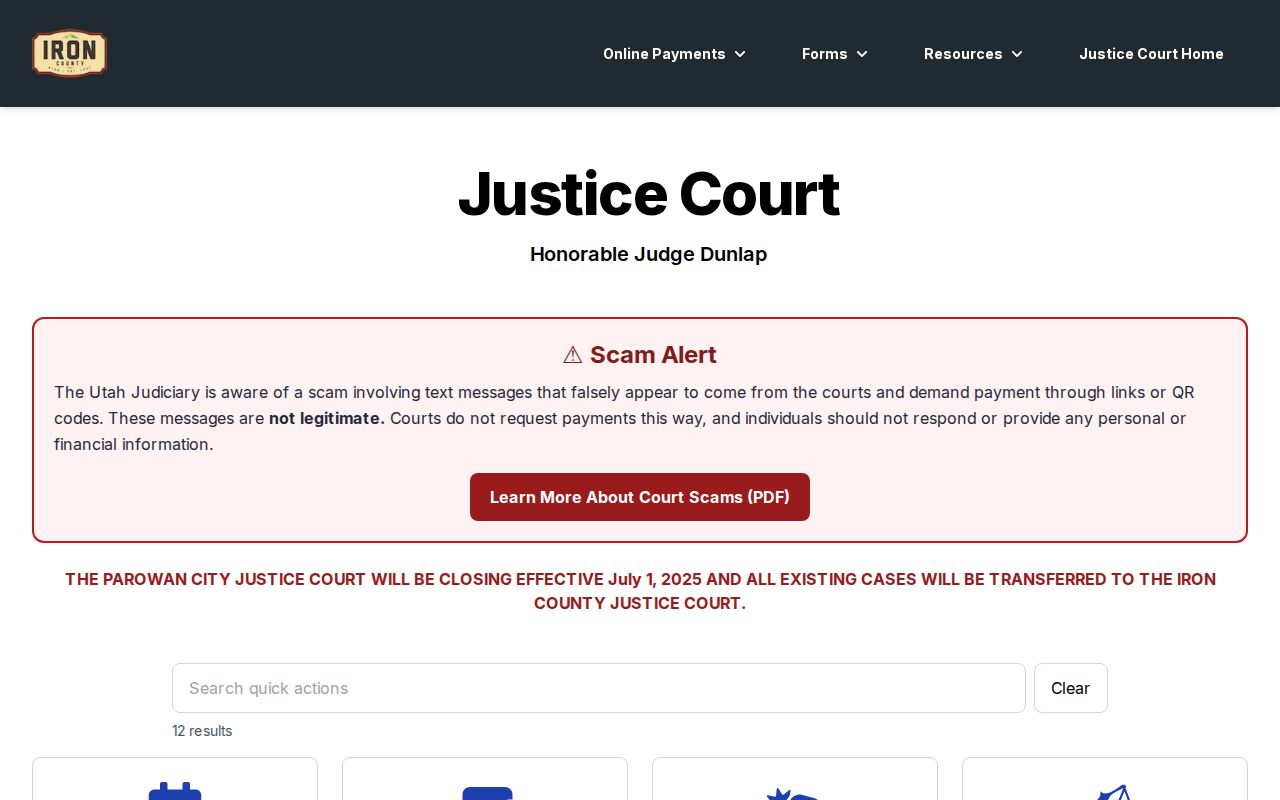
The page gives a court contact, not a separate Sheriff warrant hotline.
How Iron County Bench Warrants Are Issued
Utah Rule 6 and state traffic law set out when a judge may issue a warrant after a summons, citation, or required appearance. In Iron County, the court reviews the matter first. The order then enters the court or state system. A lower-court failure to appear does not follow the same record path as a new felony arrest warrant.
Process: required appearance or payment missed → court reviews the case → bench/FTA warrant issued → agency may serve → court recalls or changes the order after the required action.
The Utah traffic-citation statute gives the state framework. Ask the Iron County court what fits your case.
A Court-Date Request Does Not Recall It
Per Iron County Justice Court, a warrant stays active until bail is paid or the judge sees the person. Asking for a new date does nothing by itself. That trips up many people. Someone rescheduling after a missed traffic setting often assumes the request closes the matter. So confirm with the clerk before relying on it. Ask whether the new date was granted. Ask whether the warrant itself was recalled. Keep the written order or payment receipt, because a later case date and a warrant's status are two separate records.
Local rule: Confirm the court’s actual action. A pending request is not the same as a recall.
Bench Warrants and Arrest Warrants Compared
Either kind of warrant can end in arrest. The trigger and the route differ, though. A bench warrant usually follows a missed court obligation. An initial arrest warrant comes through a probable-cause process under Utah law. In Iron County, Justice Court takes most traffic and failure-to-appear matters, while felonies go to Fifth District Court. Read the issuing court and case type on your notice before you pick up the phone.
| Point | Bench or FTA | Arrest warrant |
|---|---|---|
| Typical trigger | Missed appearance or court-directed payment | Probable-cause review in a criminal matter |
| Common local route | Justice Court for traffic and ordinance cases | Fifth District or issuing magistrate |
| Who recalls | Issuing court | Issuing court |
| Agency role | May serve or transport | Agency named by the judge may serve |
Parowan’s Bench-Warrant Route Changed
Parowan City Justice Court closed. Its cases and services moved to Iron County Justice Court effective July 1, 2025. The county fee page still lists a separate Parowan payment link. That link covers cases from June 30, 2025 or earlier, and it does not mean the old counter is still open. Call before you pay through a legacy route. The citation's date and court name decide which instructions apply. Parowan is the county seat. The lower-court counter now sits in Cedar City. The official transfer notice describes the change.
Resolving an Iron County Bench Warrant
Start with a call to the issuing court. Ask which action it requires. For Iron County Justice Court matters, that may mean full payment, bail, or an appearance before the judge. Online and phone payments carry a 2.5% processing fee. The in-person window, the drop box after 4 p.m., and mail each follow separate rules. Personal checks are not accepted for criminal cases. Before paying, weigh a traffic-school, deferred, or not-guilty option, since payment can affect the underlying case. Save your proof and ask when the court will report the recall to the state file.
Bring or have ready: citation or case number, the court name, and any notice the court sent. Ask whether an appearance is still required after payment.
Justice Court or Fifth District Court?
Iron County Justice Court sits at 82 N 100 E, Suite 101, and handles traffic, infractions, class B/C misdemeanors, and county or participating-city ordinance matters. Felony and district-case records belong to Fifth District Court at 40 N 100 E. Both courts are in Cedar City. Do not mix them up. A Justice Court payment counter cannot resolve a district warrant just because the two share a town. The Fifth District location page lists the Cedar City and Parowan court sites. Use whichever court your notice names.
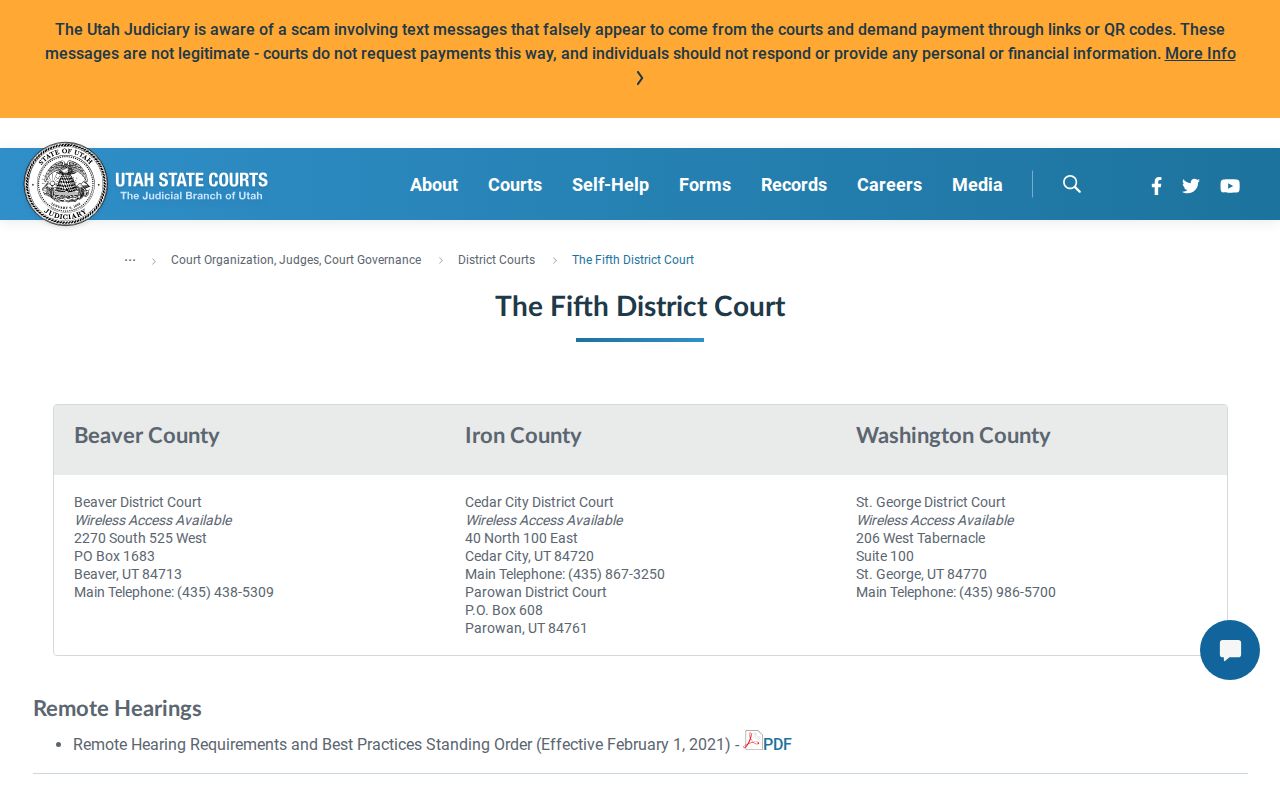
The separate addresses help distinguish the two court systems.
Finding the Court That Issued the Warrant
Read the case papers first. The elected Iron County Clerk runs county administration and is not the court clerk. The Sheriff answers service and agency-record questions, while the Jail handles custody and bond details. Only the issuing court can confirm a warrant's recall.
Juvenile and sealed matters use separate access rules; ask the appropriate clerk or counsel.
Reading an Iron County FTA Record
An Iron County bench-warrant record ties together several details. You may see a citation or case number, the original appearance date, and the warrant trigger. It can also show a payment or plea option, later court action, and service status. The public payment lookup is narrower, offering just Court, Citation or Court Case Number, and Search. That tool is not a complete active-warrant list. Keep three things distinct: the warrant flag, the payment amount, and the case disposition. Paying or appearing may address the warrant while the underlying case stays open for another date or decision.
- FTA
- Failure to appear as ordered.
- Recall
- The issuing court withdraws the warrant.
- Disposition
- The court’s later action on the underlying case.